 |
| Српски / Srpski: Mašinice za ribolov na Sajmu lova i ribolova u Novom Sadu. (Photo credit: Wikipedia) |
 |
| English: 1: Pick up or bail 2: Reel seat 3: Reel foot 4: Handle 5: Support arm 6: Anti-reverse lever 7: Skirted spool 8: Fishing line 9: Drag adjustment knob Español: 1: Pick up 2: Mango o soporte 3: Pie de sujección 4: Manivela 5: Pata del carrete 6: Sistema de bloqueo de retroceso 7: Bobina de tambor fijo 8: Bobina de alojamiento del hilo 9: Freno (Photo credit: Wikipedia) |
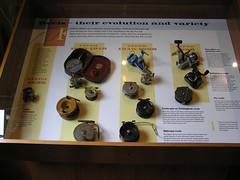 |
| Fishing Reels (Photo credit: mrpbps) |
 |
| fishing reel (Photo credit: Burp Hammie) |
Fishing reels as we know today –the
cylindrical device that is attached to a fishing rod and used in winding the
line, came into picture around 1650 AD in England and by the 1760s, it gained
popularity. Today fishing reels come according to specific types of fishing-
spinning reels, bait casting, fly fishing, surfcasting, and bait feeder reels.
Anglers choose a reel that most complements their fishing technique and brings
out the best results.
However, unlike other tackle
manufacturers, Baitbox does not believe in ‘entry level’ or beginner range. All
the reels, no matter what size come packed with quality deserving of fishermen
of every ‘level’. Most of these so called ’entry level’ reels have 1 – 3
bearings and are constructed at minimal cost but are sold in relatively higher
price when the quality and performance of the reel is taken into account. Along
with the quality, we also make sure the Baitbox fishing reels are good looking reels.
But before you are out there shopping
for the reels, isn’t it better to know what types of reels go together with
what particular style of fishing! If you are a pro and just browsing through,
you are well aware of it but the ones who are starting off might require some
assistance in this regard and hence we would elaborate a little.
Spinning fishing reels are ideal for long distance casting, works well for light
lures, a wide range of range of baits and do not backlash. These are open faced reels with fixed spools
that do not revolve while you are casting or retrieve. In order to retrieve the
line, you have to turn the reel handle. The bail will revolve round the spool
and the line is placed evenly onto the spool. For small pan fish with the lightest
pound test lines to heavy duty lines for surfcasting and trolling- these reels
are most recommended.
Fly fishing reels are simple mechanical construction operated by stripping line off the
reel with one hand and casting the rod with the other hand. Nowadays fly reels
have more sophisticated disc type drag systems. Saltwater fly reels are also
specially designed for use in the marine environment. These are however larger
in diameter to provide a large line and more backing.
Bait casting are
multiplying reels, with the spool mounted above the rod. Stainless steel,
aluminum, graphite and synthetic composite are often used as raw materials of
these reels. The graphite made reels
are lighter but the aluminum reels are most preferred as they are more stable
and rigid. Good quality bait casting
always come with high quality bearings made from shielded, double shielded or
sealed bearings.
Surfcast reels are
the ones that run freely on its axle thereby allowing distance casting. It is
used for coarse fishing and is most commonly used in Australia for all forms of
freshwater and saltwater fishing.
No matter what your style of fishing
is, you need a quality fishing tackle and from branded manufactures. The last
thing you want is for the reel to give away just when you are about to reel
that nice chunky fish! You would not want to be the one to tell the story of
the fish that got away.


